About

SpatialNext is an advisory practice — helping organisations ask the right questions before the build starts.

The AI is running. The human is present. Nobody designed what happens between them.

That gap – between machine output and the person who has to act on it – is where most AI deployments quietly fail. Not because the technology is wrong. Because nobody asked the right question before the build started:

Who is this decision for, and what does that human actually need?

I’m Matt Sheehan. AI strategist. I’ve spent 25 years at the intersection of spatial intelligence and consequential decision-making.

My thinking sits across three layers:

The sensing layer — the data infrastructure the geospatial industry spent three decades building. Satellites, IoT networks, real-time feeds covering the world at scale. Most organisations have invested heavily here.

The causal reasoning layer — systems that don’t just perceive the world but simulate it. Reasoning about cause and effect, modelling what happens if you intervene. This is arriving faster than most organisations realise.

The decision layer — the one almost nobody is designing. Which decisions the machine can settle on its own. Which ones need to reach a human, and what that human is actually authorised to do once it does. Whether the system is built to use human judgment where it matters, or skips it by default.

The third layer is where AI deployments fail. It is also where my thinking is focused.

If that layer hasn’t been designed in your organisation yet, that’s usually where the conversation starts: mattsheehan@spatialnext.io

Frameworks

The frameworks behind the thinking:

Causal Planetary Intelligence – The three-layer architecture behind everything I write: sensing, reasoning, and the human decision layer — and why the third is the one that determines whether the first two ever produce a return. Read → What is Causal PI?

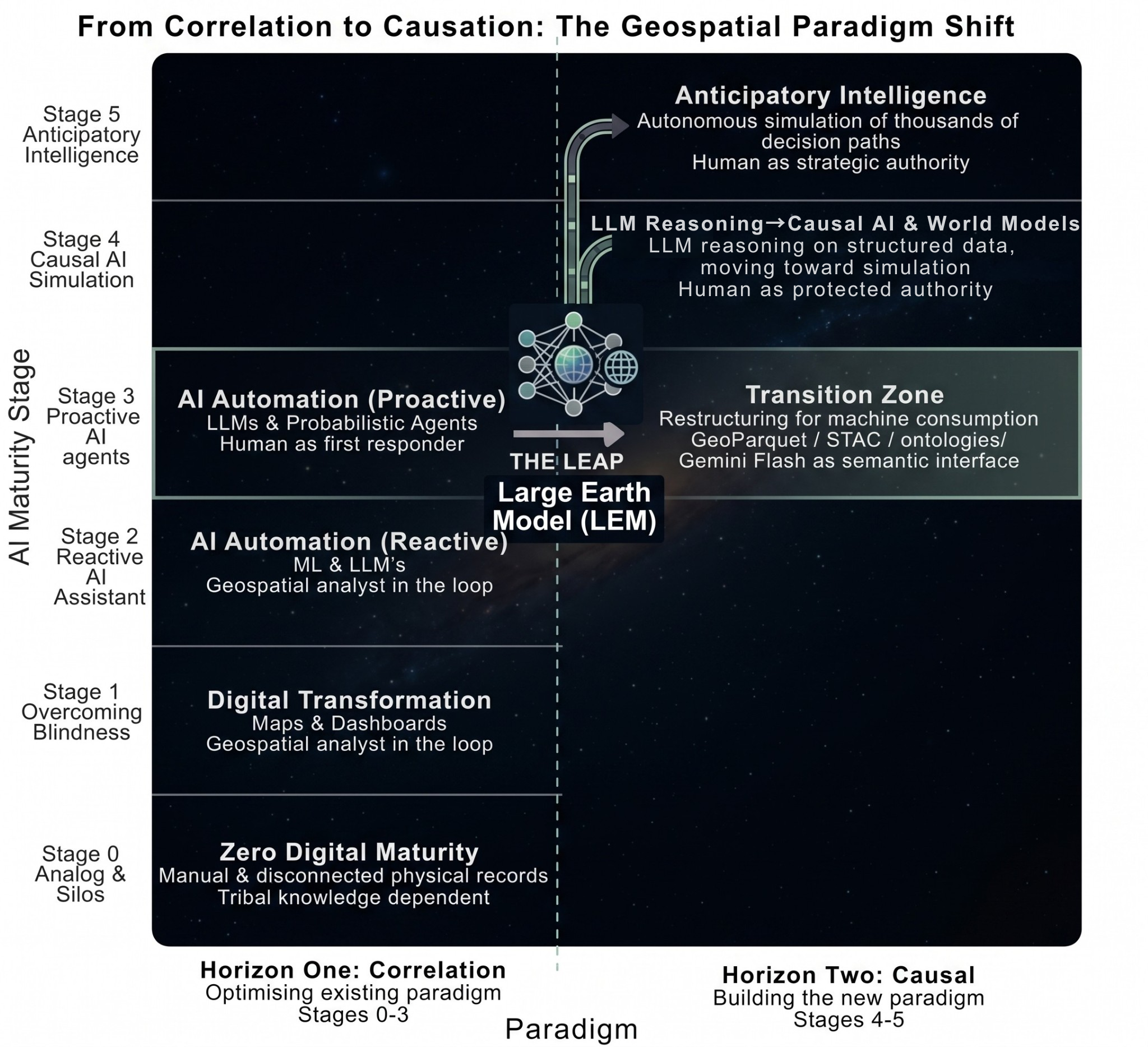
The Six-Stage AI Maturity Model – Where your organisation sits on the path from AI that describes to AI that simulates — and where human authority needs to be redesigned at each stage to keep pace. View → AI Maturity Model

The Decision Architecture Diagnostic – Sorting your AI-touched decisions into what the machine can safely settle alone, and what requires protected human judgment — then, for the judgment bucket, reading where authority, thresholds, and override rights are missing or undefined. Fast, fixed-scope, and the natural first step. Available on request mattsheehan@spatialnext.io

The Conversation

Most organisations deploying AI have the sensing layer built and the reasoning layer arriving. Almost none have asked what the human is supposed to do when it does — who receives that reasoning, what they’re authorised to do with it, and whether the system is designed to use their judgment or route around it.

That question is where the conversation starts.

mattsheehan@spatialnext.io

Writing

  • Geospatial – A Time of Opportunities & Challenges

    In the rapidly evolving world of geospatial technology, understanding the industry’s journey is crucial for businesses aiming to leverage its power for growth. This article explores the three major revolutions that have shaped the geospatial landscape, offering insights into how these changes impact market expansion and business strategies in the sector. The Web GIS Revolution:…

    Read more

  • The GenAI Marketing Revolution: Maximizing Benefits, Minimizing Risks

    In today’s rapidly evolving business landscape, staying ahead of the curve is no longer just an advantage—it’s a necessity. Enter the world of Generative AI (GenAI), a groundbreaking technology that’s reshaping how companies approach growth, marketing, and overall business strategy. The GenAI Advantage: Time, Speed, and Budget Optimization GenAI isn’t just another buzzword—it’s a game-changer…

    Read more

  • From Concept to Animation: How AI is Transforming Geospatial Marketing

    In the world of geospatial technology, standing out is crucial. As experts in both geospatial business growth and AI-generated animations, we recently undertook a project to showcase the power of digital twins in industrial and construction projects. Here’s how we transformed a simple concept into a compelling visual story: 1. Understanding the Core Product We…

    Read more

  • Geospatial Sales & Marketing is Broken: Time for an Overhaul

    In the rapidly evolving world of geospatial technology, one critical aspect often lags behind: sales and marketing. As the industry pushes the boundaries of what’s possible with GIS, LiDAR, and remote sensing, many companies struggle to effectively communicate their value and capture market share. This disconnect between innovation and market success calls for a comprehensive…

    Read more

  • LiDAR’s Business Impact: Transforming Geospatial Challenges into Growth Opportunities

    In the rapidly evolving world of geospatial technology, LiDAR (Light Detection and Ranging) has emerged as a game-changing tool for market expansion and business growth. However, many companies in the remote sensing and GIS (Geographic Information Systems) sectors struggle to translate its technical capabilities into tangible business value. This disconnect often leads to prolonged sales…

    Read more

  • Breathing New Life into Geospatial Marketing: An AI-Powered Renaissance

    In recent years, the geospatial industry has been at the forefront of a remarkable technological revolution. This transformation is reshaping how we collect, analyze, and visualize spatial data, opening up unprecedented opportunities for location intelligence and spatial analysis. As experts in geospatial marketing and geospatial business development, we’re excited to guide you through this evolving…

    Read more

  • Revolutionizing Geospatial Business Intelligence: The Generative AI Advantage

    In today’s data-driven business landscape, a groundbreaking development is transforming how companies leverage geographic information for strategic decision-making. The fusion of generative AI with geospatial technology, often called “AI-Powered GIS,” is revolutionizing how businesses interact with location-based data, offering unprecedented insights for comprehensive go-to-market strategies. Imagine asking your AI assistant, “How will urban development in…

    Read more

  • Generative AI is Transforming Geospatial Business Growth & Innovation

    As we enter a new era of technological advancement, the integration of Artificial Intelligence (AI) and Machine Learning (ML) into geospatial processes is accelerating at an unprecedented pace. This fusion, known as geospatial AI, is set to revolutionize how businesses interact with and understand their world, offering innovative growth opportunities across numerous sectors. In the…

    Read more

  • Advancements in GeoAI: Enhancing Geospatial Workflows

    Recent developments in Artificial Intelligence (AI) are bringing exciting new capabilities to Geographic Information Systems (GIS). These advancements have the potential to significantly enhance geospatial workflows and address complex challenges in the field. Pretrained Models and GeoAI Toolbox Updates A comprehensive library of over 70 pretrained models is now available for GIS professionals. These models…

    Read more

  • Generative AI: A Geospatial Business Game Changer

    In the rapidly evolving landscape of geospatial business, staying ahead of the curve requires innovative strategies and cutting-edge technology. Generative AI is one such technology that is not just a buzzword but a transformative tool that can significantly impact how businesses operate, engage with customers, and drive growth. Generative AI: More Than Just Eye Candy…

    Read more

A WordPress.com website

SpatialNext

AI is running. Nobody designed what the human does next.

801.733.0723

mattsheehan7365@gmail.com

Proudly powered by WordPress