The Opportunity-to-Value Framework
Most AI programmes don’t fail because the technology is wrong. They fail because the journey from first idea to real business value was never properly designed. The OVF is that journey — from the right question, through the right build, to lasting impact.
The Delivery Journey
Opportunity discovery & prototyping — the why
Are we solving the right problem?
“Does this solve a genuinely high-value problem — or are we building for its own sake?”
Most AI initiatives start with a technology looking for a problem. This phase reverses that. Before a single line of code is written, the team works closely with the customer to understand the real challenge — using design thinking, empathy, and rapid iteration to test hypotheses at low cost and high speed.
Wireframes, sandboxes, and collaborative workshops replace premature engineering commitments. The output is not a prototype — it is confidence that the right problem has been found and a credible solution path exists.
- Opportunity discovery — identify the business need before committing resources
- Brainstorm & empathise — understand the as-is state with the client
- Problem framing — distil findings into a clear, testable hypothesis
- Rapid prototyping — co-create tangible concepts with end users, fast
- Prototype sign-off — formal agreement before moving to build
MVP — the how
Can we actually build and deliver this?
“Can we technically execute this at scale with our current platform and data?”
This is where the idea becomes a working, testable product. Requirements are formalised, data pipelines built, development executed in sprints, and quality tested against real-world conditions. The client remains closely involved throughout — the MVP is built to validate, not just to demonstrate.
The gap between a working prototype and a production system is where most AI initiatives stall. This phase exists to surface and resolve that gap before the full production commitment is made.
- Scoping & requirements — define the leanest functional version that proves the concept
- Data pipeline — build, validate, and confirm data is production-ready
- Development sprints — iterative build with continuous client feedback
- Testing & QA — rigorous acceptance review before release
- Deployment — controlled rollout with readiness and security review
Product — the what
Does it reach the business and stick?
“Is there human or process friction that will prevent adoption?”
Technology that works but isn’t used delivers nothing. This is the most frequently missed phase in AI delivery — and the most expensive failure mode. The production phase focuses on onboarding, adoption, value realisation, and building the commercial foundation for growth.
A successful delivery is not the end. It is the start of the next cycle — expansion, renewal, and the continuous loop that turns one successful initiative into a maturing AI capability.
- Onboarding & training — scaled adoption with real operational integration
- Value realisation — KPI measurement against original business objectives
- Continuous improvement — feedback loop that keeps the solution fit for purpose
- Expansion & renewal — outcomes reviewed, next capability cycle initiated
Why most AI programmes stall — and where the OVF intervenes
- Technology-led, not outcome-led. The initiative starts with a tool, not a problem. Phase 1 forces the right question before anything is built.
- Skipping discovery. Moving straight from idea to development without validating the hypothesis. The prototype phase exists to make this cheap to get wrong — and expensive to skip.
- Prototype mistaken for production. A demo becomes a commitment before technical feasibility is tested at scale. Gate 2 prevents it.
- Adoption treated as an afterthought. No onboarding architecture, no change management, no readiness check. Gate 3 makes it mandatory before sign-off.
- No commercial thread. The initiative lives in engineering with no line to business value, renewal, or growth. Phase 3 closes that gap.
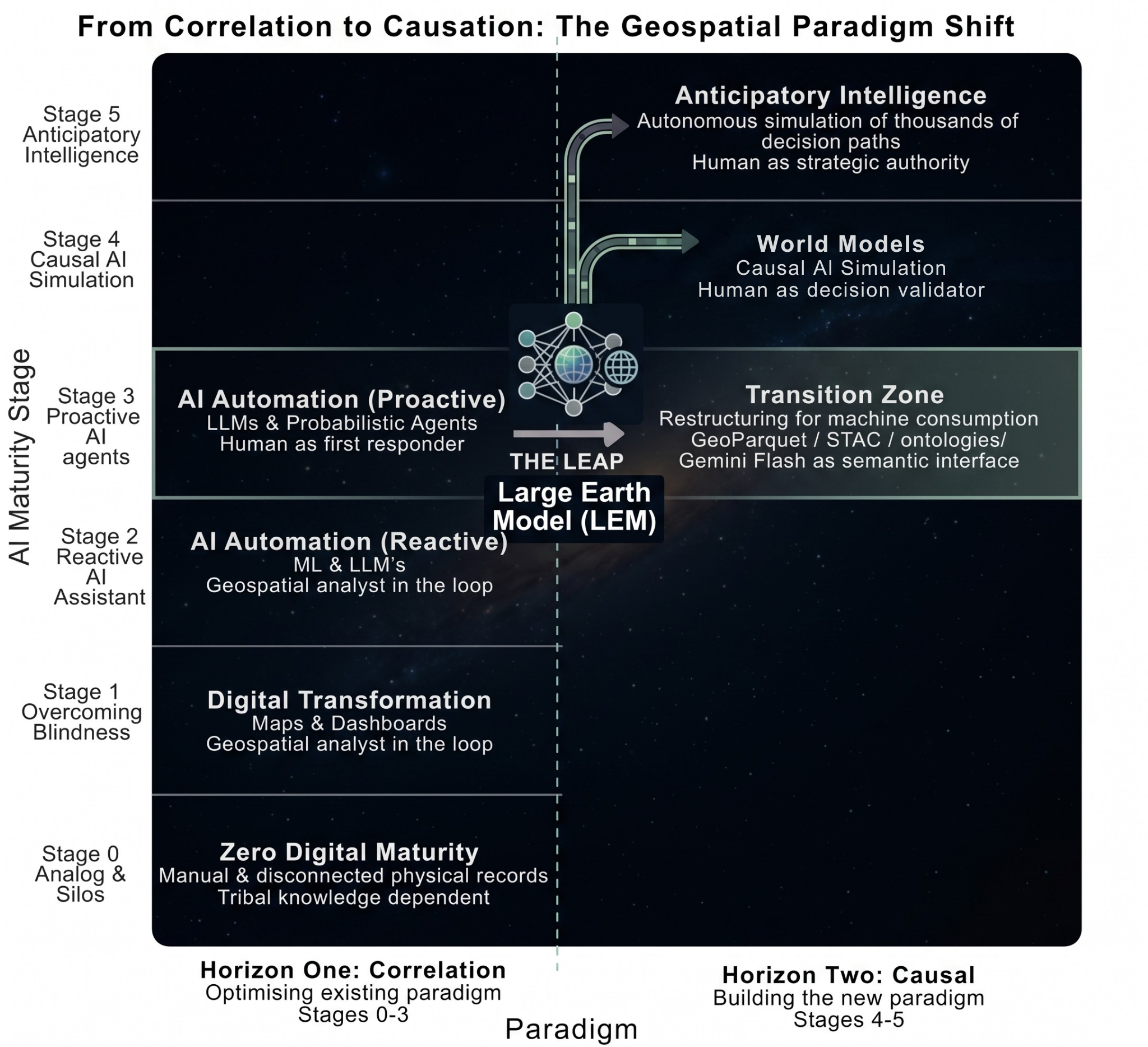
The OVF sits alongside the Six-Stage AI Maturity Model as part of a broader framework for navigating the transition from AI that describes the world to AI that reasons about it. Questions — get in touch.